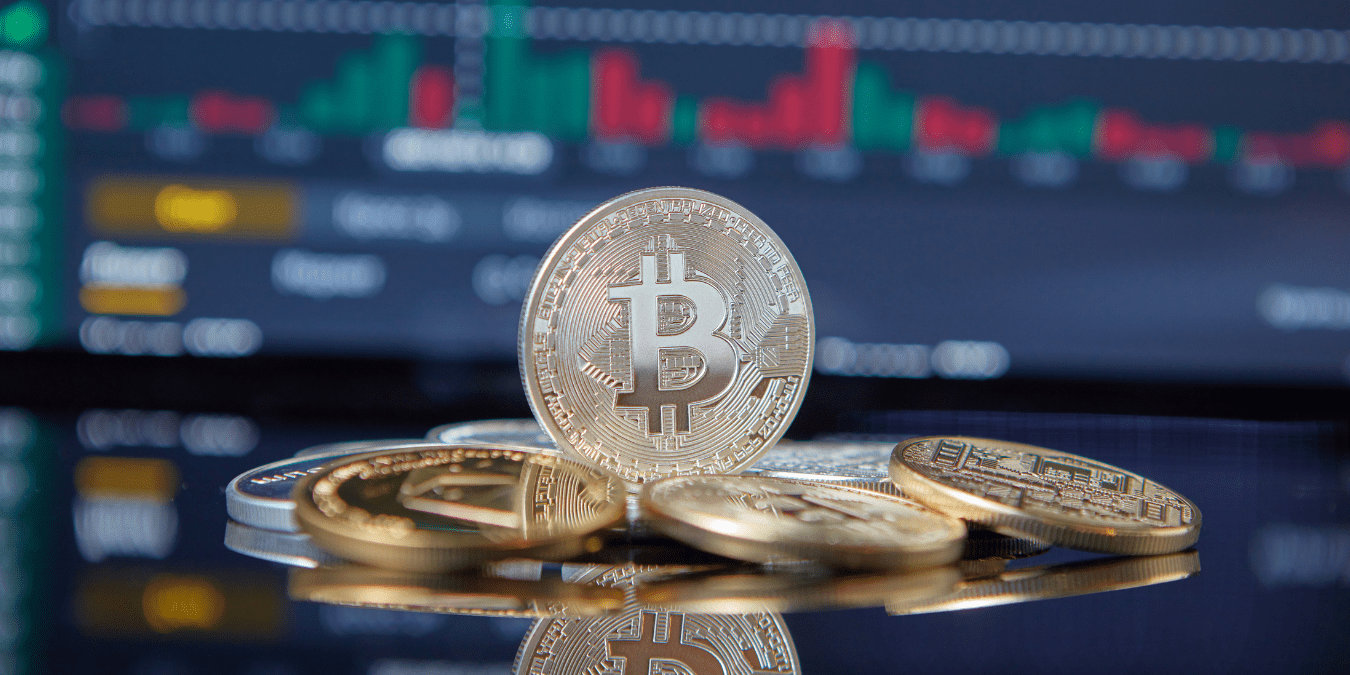
There is a quiet revolution happening in the way Americans think about money, risk, and safety. While Wall Street stumbles under the weight of geopolitical tension, trade war tremors, and an equity market that has endured its longest losing streak since the 2022 bear market, one asset class is doing something unexpected — Bitcoin is holding ground, climbing past $75,000, and attracting record institutional capital. The question every serious investor across America is now asking is no longer whether Bitcoin is legitimate. The question is whether Bitcoin is becoming the last safe harbor in a storm-tossed financial world.
The State of the U.S. Market Right Now
To understand why Bitcoin’s resilience is so striking, you first need to understand just how rattled traditional U.S. markets have become in 2026. The U.S. stock market recently closed its fifth consecutive losing week — the longest losing streak since the 2022 bear market. The Nasdaq entered correction territory, falling more than 11% year to date, while the S&P 500 dropped roughly 7%, sitting nearly 9% below its all-time high set in January. Trillions in market value have evaporated in a matter of weeks.
What is driving this turbulence? President Trump’s repeated tariff threats against European partners rekindled the “Sell America” trend that first appeared after Liberation Day tariff declarations, sending the Cboe Volatility Index surging to an eight-week high of 20.69. Simultaneously, major U.S. equity benchmarks dropped to their lowest level since September, driven by rising anxiety over a prolonged conflict in the Middle East, with the S&P 500 finishing 1.5% lower and the Nasdaq 100 declining 1.9% in a single session. Expert analysis warns that sustained oil price surges, central bank hawkishness, and the risk of an oil-driven recession represent three converging storms that could hit equity markets with full force.
This is the economic backdrop against which Bitcoin’s current performance must be measured. And it is a backdrop that makes Bitcoin’s story far more compelling than at any prior moment in its history.
Bitcoin’s Price Story in 2026
Bitcoin opened 2026 carrying enormous momentum from a landmark 2025 — the year spot Bitcoin ETFs went mainstream, institutional adoption exploded, and the U.S. government formalized a Strategic Bitcoin Reserve. As of April 17, 2026, Bitcoin was trading at $75,746.90, representing a $960 jump from the prior day. Intraday futures data showed Bitcoin touching $78,545 on that same date, a level that confirms the $76,000-plus range is within live market territory.
Price forecasters at Changelly project Bitcoin reaching $77,752 by April 23, 2026, with the month’s potential high touching $82,714. The average April 2026 price is expected to settle around $79,005. While Bitcoin’s price remains approximately $9,200 lower than the same period one year ago, the directional momentum — particularly in a market environment where equities are bleeding — is undeniably upward.
This is not a speculative moonshot narrative. This is a measured, institutionally-driven climb happening in real time, in the middle of one of the most chaotic macro environments the United States has seen in recent memory.
The Institutional Takeover Is Real
One of the most transformative stories of 2025-2026 is the sheer scale of institutional money flowing into Bitcoin. This is not retail investors buying fractions of a coin on a mobile app. This is Wall Street’s biggest names making billion-dollar commitments. Strategy (formerly MicroStrategy) made headlines in April 2026 when it purchased an additional 34,164 Bitcoin for $2.5 billion, pushing its total holdings past 800,000 BTC — a staggering position that reflects deep conviction in Bitcoin as a long-term store of value.
Bitcoin ETFs recorded their single strongest inflow day of 2026 in January, attracting $843.6 million in one trading session, with BlackRock’s iShares product alone pulling in over $648 million. Fidelity’s Wise Origin fund contributed an additional $125.4 million in that same session, extending a three-day rally that brought total deposits above $1.7 billion. By April 2026, Bitcoin ETFs had accumulated $23.6 billion in net flows for the year, though gold ETFs still lead with $44.4 billion — a gap that reflects Bitcoin’s evolving, but not yet complete, transition into safe-haven territory.
Over 30 top Wall Street and crypto-native firms now view Bitcoin as a strategic reserve asset. Over 41% of hedge funds plan to allocate to cryptocurrency, while sovereign wealth funds including Norway’s Government Pension Fund have begun pilot Bitcoin reserves. Morgan Stanley has also announced plans to offer Bitcoin ETF allocation options to its private wealth clients by 2026 — a move that would have been unthinkable five years ago.
Bitwise analysts predict that by end of 2026, more than one million BTC will be accumulated under the new corporate treasury paradigm, with institutional funds expected to inject approximately $300 billion into Bitcoin during the year. These are not speculative projections from crypto boosters — they are consensus-level forecasts from regulated asset managers operating within the traditional financial system.
Washington’s Endorsement Changes Everything
Perhaps the single most important development shaping Bitcoin’s trajectory in 2026 is not happening in a trading room — it is happening in Washington, D.C. President Trump’s first term back in office brought unprecedented federal support for digital assets, including the establishment of a Strategic Bitcoin Reserve and the appointment of David Sacks as the nation’s first “Crypto Czar.” The executive order governing the reserve explicitly separated Bitcoin from all other cryptocurrencies, designating it as the sole asset in the strategic reserve — a distinction with profound implications for Bitcoin’s legitimacy as a national-level financial instrument.
All Bitcoin currently held by the U.S. government automatically entered the reserve under the order, with an explicit clause preventing its sale — a protection not extended to altcoins. Cathie Wood of ARK Invest argues that the U.S. government could begin actively purchasing Bitcoin in 2026 as part of the reserve, moving beyond simply holding seized BTC toward intentional acquisition. According to the Bitcoin Act framework, the United States could purchase 200,000 BTC annually — a buying program that would fundamentally alter supply dynamics in a market where 95.12% of all Bitcoin had already been mined by January 2026.
The signal this sends to international markets is enormous. When the world’s largest economy formally integrates a digital asset into its national treasury strategy, it does not merely legitimize that asset — it restructures the global conversation about what constitutes sound monetary reserves.
Is Bitcoin Actually a Safe Haven? The Honest Answer
Any credible analysis of Bitcoin’s safe-haven status must grapple honestly with the complexity of the question. Bitcoin does not behave exactly like gold. During the Middle East escalation of early 2026 — when the Strait of Hormuz faced disruption threats and Brent crude spiked as much as 13% in a single session — Bitcoin initially dropped to around $63,000 alongside risk assets before rebounding toward $68,600. Its short-term correlation with the S&P 500 remains elevated at approximately 0.55, meaning Bitcoin still sells off alongside equities when acute fear grips markets.
During Trump’s tariff shocks and trade war flare-ups, Bitcoin has exhibited risk-asset behavior — falling on liquidity concerns and higher-for-longer rate expectations — while gold rises reliably on geopolitical tension. Historical precedent from the 2022 Russia-Ukraine conflict shows Bitcoin often drops sharply in the initial phase of geopolitical crises before recovering, while gold provides more immediate stability.
So Bitcoin is not a perfect safe haven. But here is the critical reframe: Bitcoin does not need to be perfectly safe to be the best available bet for a growing class of American investors. Here is why:
- Gold is already pricing in fear. Gold ETFs have accumulated $44.4 billion in net flows in 2026. The crowded trade in gold means its upside may be limited relative to Bitcoin, which is still in its institutional adoption phase.
- Equities are deeply vulnerable. With the Nasdaq down 11% and trade war risks unresolved, the traditional “buy the dip” playbook for stocks carries substantially higher risk than it did in prior cycles.
- Bitcoin rebounds faster. Unlike traditional assets that can be trapped in multi-year bear cycles by structural economic damage, Bitcoin’s rebounds from geopolitical-driven selloffs have historically been sharper and more complete.
- The supply shock is real. With over 95% of Bitcoin already mined, institutional and governmental demand is colliding with structural scarcity in a way no other asset class experiences.
American Crypto Ownership Is Climbing
The American public is not sitting on the sidelines. Cryptocurrency ownership in the United States has climbed back to 30% in 2026 — a figure that represents tens of millions of Americans with skin in the game. Among current crypto owners, 61% plan to buy even more this year, signaling that belief in the asset class among those who hold it has never been stronger.
While retail investment faces headwinds from slower income growth and macroeconomic caution, the key insight from analysts is that altcoins bear the brunt of retail pullback while Bitcoin remains relatively insulated. Bitcoin’s institutional foundation provides a demand floor that speculative altcoins simply do not possess — making it categorically different from the crypto assets that collapsed during the FTX-era meltdown.
For everyday Americans thinking about wealth protection in an environment of trade wars, geopolitical instability, a weakening dollar narrative, and equity volatility, Bitcoin now occupies a unique position: it is the only asset with both the grassroots adoption of a people’s currency and the institutional infrastructure of a Wall Street product.
The Dollar Weakness Factor
A dimension of Bitcoin’s 2026 story that deserves serious attention is the backdrop of dollar weakness. Institutional demand and U.S. dollar weakness are identified by ARK Invest as the two key drivers of Bitcoin’s recent price strength. When the dollar weakens — as it does under conditions of trade uncertainty, fiscal expansion, and geopolitical distrust — Bitcoin becomes relatively more attractive as a dollar-denominated asset that cannot be inflated away.
The “Sell America” trend that Trump’s tariff threats have periodically triggered is not simply a stock market phenomenon — it reflects a broader global re-evaluation of U.S. asset credibility. International investors moving away from dollar-denominated treasuries and equities need somewhere to put capital. Bitcoin, increasingly integrated into global financial infrastructure through regulated ETFs and sovereign reserve frameworks, is a natural destination.
This is a structural argument for Bitcoin that transcends any single news cycle. If the dollar’s reserve currency status faces sustained pressure — not collapse, but erosion — Bitcoin stands to benefit in ways that no equity or bond can replicate.
What Serious U.S. Investors Should Know
The conversation about Bitcoin has matured dramatically. In 2020, institutional Bitcoin investment was a novelty. In 2023, it was a debate. In 2026, it is a fait accompli. Grayscale’s research describes 2026 as the year of “accelerating structural transformation,” with advisory wealth and institutional investors broadening adoption at a pace that redefines Bitcoin’s market character. Fidelity and Capital Group have made direct investments in Bitcoin treasury firms, signaling that the largest asset managers in America are not just offering Bitcoin exposure to clients — they are integrating Bitcoin into their own corporate strategies.
For U.S. investors navigating a war-rattled market, the evidence points toward several concrete conclusions:
- Bitcoin is not a replacement for diversification, but it has earned a legitimate place within a diversified portfolio as both a growth asset and a macro hedge.
- The regulatory environment under the Trump administration has shifted from adversarial to supportive, removing one of the primary institutional barriers that suppressed Bitcoin allocation in prior years.
- Bitcoin’s performance floor is rising. With the U.S. government, sovereign wealth funds, and the world’s largest ETF providers holding Bitcoin, the likelihood of Bitcoin returning to five-figure lows diminishes with each passing month of institutional accumulation.
- Timing matters less than positioning. With Bitcoin forecast to average nearly $79,000 in April 2026 and directional momentum intact, the question for most investors is not “if” but “how much.”
The Bigger Picture
History will likely record 2024 through 2026 as the triennium in which Bitcoin completed its transition from a counterculture experiment to a pillar of the global financial architecture. The forces converging on Bitcoin right now — a formal U.S. strategic reserve, Wall Street ETF infrastructure, sovereign wealth fund allocation, a post-halving supply squeeze, and a macro environment that punishes complacency in traditional assets — are not coincidental. They are the culmination of fifteen years of technological, regulatory, and cultural development arriving at precisely the moment the traditional financial system needs an alternative.
With U.S. equities enduring their worst streak in years and geopolitical risk showing no signs of abating, the investment thesis for Bitcoin in 2026 has never been more coherent. It is not about replacing gold. It is not about ignoring risk. It is about recognizing that in a world where every major asset class is under pressure, the asset with the strongest institutional backing, the most verifiable supply constraints, and the clearest government endorsement deserves serious consideration as a portfolio cornerstone.
Bitcoin above $76,000 is not a bubble. It is a barometer. And right now, it is reading: structural demand, rising legitimacy, and a market looking for something it can trust.
Disclaimer: This article is for informational purposes only and does not constitute financial advice. All investment decisions should be made in consultation with a qualified financial advisor. Cryptocurrency investments involve significant risk, including the possibility of total loss of principal.