Wall Street is at a fascinating crossroads. After the Nasdaq’s historic 13-session winning streak snapped on Monday, geopolitical shockwaves from the Middle East are rattling oil markets while blockbuster earnings from UnitedHealth Group are lifting spirits on Tuesday morning. Whether you’re a seasoned portfolio manager or a first-time retail investor, one question looms large: where are U.S. stock market trends heading right now — and what should you actually do about it?
This comprehensive market briefing cuts through the noise, serving up the freshest April 21, 2026 data, expert analysis, actionable stock picks, and a sector-by-sector breakdown designed to give your portfolio a decisive edge.
The Big Picture: U.S. Market Overview
The U.S. equity market entered Tuesday, April 21, 2026, with cautious optimism after a turbulent Monday. Major indices slipped on April 20 as U.S.–Iran tensions reignited, with the S&P 500 falling approximately 0.24% to close at 7,109.14, the Dow Jones Industrial Average slipping marginally to 49,442.56, and the Nasdaq Composite dropping 0.26% to 24,404.39, ending its remarkable 13-session winning streak — its longest positive run since 1992.
Tuesday’s pre-market told a different story. Futures for the Dow Jones climbed 0.6%, while S&P 500 and Nasdaq futures indicated gains of 0.4% and 0.5%, respectively, propelled by a blowout earnings report from UnitedHealth Group. This is Wall Street’s perennial tug-of-war between macro headwinds and corporate fundamentals, and right now, fundamentals are fighting back hard.
Investor sentiment remains broadly constructive. Morgan Stanley’s Global Investment Committee projects near double-digit percentage returns for the S&P 500 in 2026, with a target of around 7,500. Ed Yardeni of Yardeni Research goes even further, forecasting the S&P 500 at 7,700 by year-end, representing roughly 12.5% upside from current levels, contingent on continued earnings resilience. The bull market, now in its fourth consecutive year, is alive — but it’s navigating a minefield of geopolitical risk, sticky inflation, and an evolving Federal Reserve leadership transition.
Key Economic Drivers Shaping Wall Street in 2026
GDP Growth: Resilient But Not Invincible
The U.S. economy is holding up better than many feared. The Federal Reserve’s March 2026 projections revised real GDP growth upward to 2.4% for 2026, up from 2.3% in December’s forecast and just 1.8% in September 2025. Fed officials cited resilient consumer spending and expanding private investments as key drivers of the upgrade. This “Goldilocks” backdrop — solid growth without overheating — has been a cornerstone of the 2026 bull thesis.
However, investors shouldn’t be lulled into complacency. Charles Schwab’s 2026 market outlook describes the current cycle as characterized by “instability rather than mere uncertainty,” warning of rapid shifts in key determinants that are affecting sectors and consumers unevenly, creating a K-shaped economic backdrop. The divergence between high-income consumers (thriving) and lower-income households (squeezed by affordability pressures) remains a latent risk.
CPI Inflation: The Stubborn Variable
Inflation remains Wall Street’s most watched metric — and the March 2026 CPI reading delivered a jolt. The Consumer Price Index surged +0.9% in March 2026, driven primarily by a record spike in gasoline prices, though core CPI (excluding energy and food) rose a more measured 0.2%. Year-over-year wage growth sits at +3.5%, approaching the 3.0–3.5% range the Fed considers consistent with its 2% inflation target.
Schwab’s analysts warn that inflation could remain “sticky and closer to 3% vs. 2%,” particularly given upside energy cost risks from the ongoing Middle East situation. This inflationary stickiness is precisely why the Federal Reserve remains in a holding pattern rather than aggressively cutting rates.
Federal Reserve: Kevin Warsh Takes Center Stage
The single most anticipated macro event of April 21, 2026 is the Senate Banking Committee confirmation hearing for Federal Reserve Chair nominee Kevin Warsh. Markets are watching carefully, as Warsh’s monetary policy philosophy will shape interest rate decisions for years to come. The current federal funds rate stands at 3.50% to 3.75%, with the Fed holding steady and projecting one quarter-point cut by year-end 2026, taking the rate to approximately 3.4%.
In plain language: the Fed wants to cut but needs more confidence that inflation is durably declining before pulling the trigger. The March unemployment rate of 4.3% — edging up partly due to labor force contraction — and March payroll additions of +178,000 suggest a labor market that is cooling but not collapsing.
Latest Market News Highlights: What’s Moving the Needle
The Iran Factor: Oil Shock and Market Jitters
The dominant macro story of April 2026 is the U.S.–Iran military conflict and its tenuous ceasefire. On April 8, 2026, the Dow surged over 1,300 points — its best single-day performance in nearly a year — after President Donald Trump announced a conditional two-week ceasefire with Iran, which temporarily allowed passage through the Strait of Hormuz. Oil prices plunged on the news, recording their biggest single-day drop since the pandemic.
But by April 20–21, ceasefire deadline uncertainty triggered a fresh bout of risk aversion. Oil futures surged again, dragging equities lower and sending energy stocks higher. Goldman Sachs analysts have warned that Brent crude could average over $100 per barrel through 2026 if the Strait of Hormuz remains closed. For investors, the Iran variable is the wild card that can override every other bullish data point in a matter of hours.
UnitedHealth Group Beats Estimates, Lifts Healthcare Sector
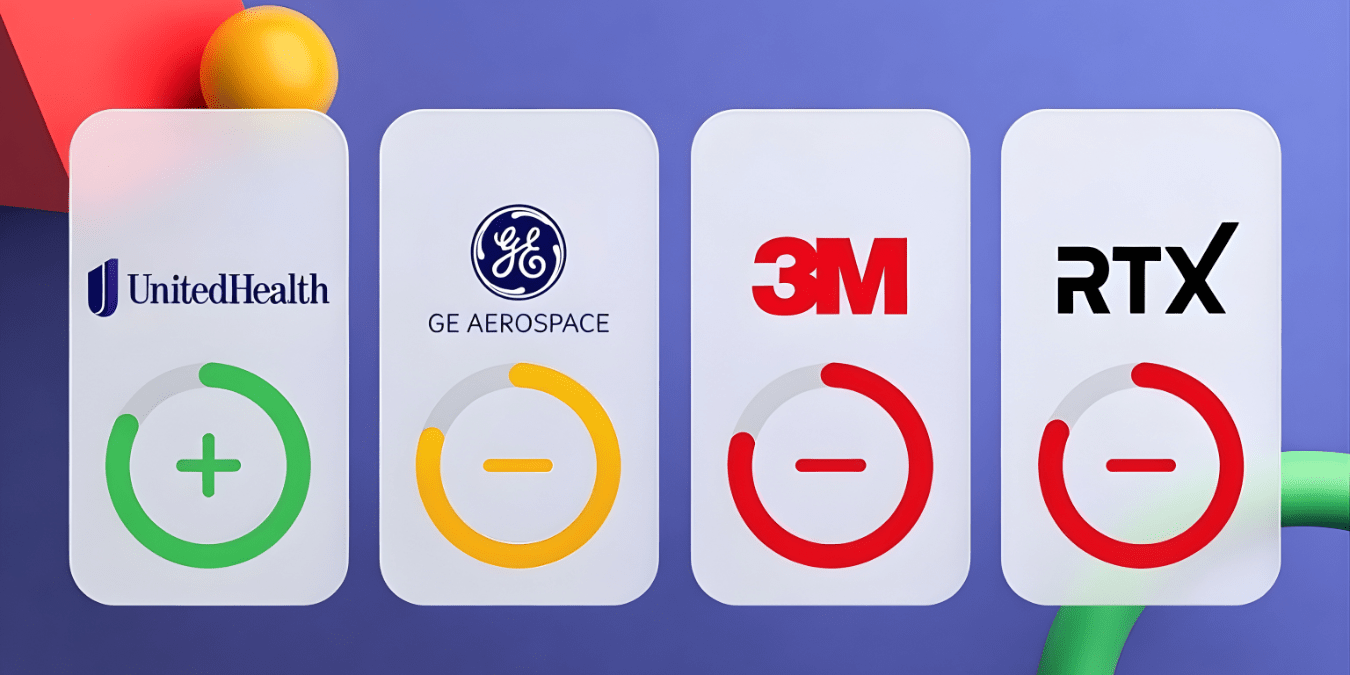
UnitedHealth Group (UNH) delivered one of the most significant earnings beats of the quarter on April 21, 2026, reporting Q1 revenue of $111.72 billion (up from $109.58 billion a year earlier) and adjusted EPS of $7.23, beating Street estimates. More importantly, the company raised its full-year 2026 adjusted EPS guidance to greater than $18.25 (from $17.75 previously), signaling confidence in managing elevated medical costs. UNH shares soared over 6% in pre-market trading, dragging the broader healthcare sector and Dow futures higher.
The Nasdaq’s Historic Streak and Its End
The Nasdaq Composite’s 13-session winning streak — its longest since 1992 — came to an abrupt halt on April 20. This streak was powered by the AI capex boom, strong mega-cap tech earnings, optimism around Fed rate cuts, and reduced trade dispute intensity. The end of the streak does not signal a trend reversal, but it does reflect the market’s sensitivity to geopolitical headlines. AI infrastructure spending by hyperscalers (Microsoft, Alphabet, Amazon, Meta) remains one of the most powerful secular tailwinds in the market.
Trump Administration Hikes Medicare Advantage Rates
The Trump administration finalized a significant increase in Medicare Advantage payment rates for 2027, delivering a direct financial tailwind for UnitedHealth, Humana, and other large health insurers. This policy catalyst, combined with strong Q1 results, is repositioning healthcare as a defensive-growth sector in investor portfolios.
Foreign Index Movements That Influenced U.S. Markets
Global markets set the tone for U.S. trading throughout April 2026. Key foreign index movements include:
- European markets (DAX, FTSE 100, CAC 40): Fell sharply mid-April on Iran war fears before recovering partially after the ceasefire announcement; energy stocks in Europe surged.
- Nikkei 225 (Japan): Benefited from a weakening yen and AI-driven semiconductor demand, posting gains in early April before Iran tensions triggered a pullback.
- Hang Seng (Hong Kong): Volatile on tech sector regulation and China growth concerns; modest negative influence on U.S. tech sentiment.
- MSCI Europe: Underperformed the S&P 500, expected to gain only ~4% in 2026 vs. U.S. outperformance, as Morgan Stanley noted.
- Oil-exporting market indices (Saudi Tadawul): Surged on elevated crude prices, indirectly validating the risk-off rotation in U.S. markets.
Top 10 Stocks to Buy on NYSE/NASDAQ for 2026
These picks blend growth, valuation discipline, and sector catalysts appropriate for a 2026 portfolio:
Today’s Top 10 Gainers and 10 Losers (April 21, 2026)
Markets reacted to a complex mix of earnings beats, geopolitical unease, and sector rotation. Here’s a breakdown of the notable movers:
Top 10 Gainers
Top 10 Losers
Sector Performance: Where the Real Money Is Moving in 2026
The 2026 market story is fundamentally a sector rotation story. Here is how major sectors stack up:
Technology remains the undisputed heavyweight, fueled by what Wall Street has christened the “AI capex boom.” Morgan Stanley projects U.S. equities to outperform global peers in 2026, partly because American tech companies are the primary beneficiaries of global AI infrastructure spending. Healthcare has emerged as the surprise co-leader of 2026, thanks to GLP-1 drug tailwinds and now UnitedHealth’s earnings beat. Energy is the wild card — directionally bullish on geopolitical supply risk but vulnerable to any durable ceasefire resolution.
Analysis and Recommendations: Building Your 2026 Portfolio
The Core Macro Framework
Before picking individual stocks, internalize the macro framework: the Fed is on hold with one expected cut late in 2026, inflation is sticky near 3%, GDP growth is solid at 2.4%, and the labor market is cooling — not collapsing. The bull market’s fourth year has historically been its most volatile, and the Iran war adds an unprecedented geopolitical variable. The reward for navigating this correctly? Morgan Stanley’s 14% S&P 500 upside target; the risk for getting it wrong? A pullback driven by energy shock or inflation re-acceleration.
Diversified Portfolio Suggestions by Risk Appetite
Conservative Portfolio (Capital Preservation + Income)
- 40% Blue-chip dividend payers: JPMorgan Chase (JPM, ~2.1% yield), Walmart (WMT), Procter & Gamble (PG)
- 30% Healthcare defensives: UnitedHealth (UNH), Medtronic (MDT)
- 20% Short-duration Treasuries / Bond ETFs: Hedge against rate volatility
- 10% Energy: Modest exposure to oil upside via XOM or CVX
- Pros: Low volatility, income generation, downside protection. Cons: Limited AI/tech upside participation.
Moderate Portfolio (Balanced Growth + Stability)
- 35% Large-cap tech: Microsoft (MSFT), Broadcom (AVGO), Alphabet (GOOGL)
- 25% Healthcare: Eli Lilly (LLY), UnitedHealth (UNH)
- 20% Industrials/Infrastructure: Comfort Systems (FIX), GE Aerospace (GE)
- 15% Financials: JPMorgan (JPM), Goldman Sachs (GS)
- 5% Cash: Tactical dry powder for volatility dips
- Pros: Captures AI tailwind + defensive ballast. Cons: Still exposed to macro shocks.
Aggressive Portfolio (High Growth / High Risk)
- 50% High-growth tech: Nvidia (NVDA), Micron (MU), Meta (META), Amazon (AMZN)
- 20% Emerging AI infrastructure plays: Comfort Systems (FIX), Corning (GLW), Western Digital (WDC)
- 20% Healthcare innovation: Eli Lilly (LLY), Moderna (MRNA)
- 10% Energy momentum: Leverage oil upside during Iran tensions
- Pros: Maximum exposure to 2026’s secular growth themes. Cons: High beta — vulnerable to rate shock, geopolitical escalation, or valuation compression.
Actionable Insight: The Trade of the Week
With Kevin Warsh’s Senate confirmation hearing on April 21, markets will be scrutinizing every word for signals about the Fed’s policy trajectory under new leadership. If Warsh signals a more hawkish lean than Jerome Powell, expect bond yields to spike and rate-sensitive growth stocks to sell off — creating a buying opportunity in high-quality tech names that pulled back. Conversely, dovish language could re-ignite the Nasdaq rally. Positioning in broad S&P 500 index funds ahead of the hearing, while holding tactical cash for post-hearing reallocation, is the prudent play for most retail investors.
The UnitedHealth earnings beat is not just a single-stock story — it validates that corporate America is managing cost inflation better than feared, which is broadly bullish for Q1 earnings season. Watch GE Aerospace, 3M, and Northrop Grumman, all scheduled to report this week, as they will set the tone for industrials and defense.
Final Thought
Today’s U.S. stock market landscape is a study in contrasts: a Nasdaq that just snapped its longest winning streak in over three decades, an oil market held hostage to ceasefire negotiations, a Federal Reserve in leadership transition, and corporate earnings that continue to beat expectations with stubborn regularity. The S&P 500 sits at 7,109 — well below Morgan Stanley’s 7,500 target and significantly short of Yardeni’s 7,700 forecast — which means the math still points to meaningful upside for patient, disciplined investors.
The three non-negotiable themes for 2026 remain: AI infrastructure (Nvidia, Microsoft, Broadcom), healthcare disruption (Eli Lilly, UnitedHealth), and energy geopolitics (the wildcard that could make or break year-end returns). The Federal Reserve, CPI trajectory, and the Iran situation are the macro variables demanding weekly monitoring.
Don’t let the daily noise — a 0.24% S&P pullback, a snapback in oil — distract from the bigger picture: the bull market is intact, corporate fundamentals are strong, and the AI revolution is generating real earnings growth, not just hype. The investors who tune out the panic and stay focused on these secular trends are the ones who will be celebrating come December 31, 2026.
Disclaimer: This blog post is for informational and educational purposes only and does not constitute financial advice. Always conduct your own due diligence or consult a licensed financial advisor before making investment decisions. Data sourced from the Federal Reserve, U.S. Bureau of Labor Statistics, NYSE, NASDAQ, CNBC, Reuters, Morgan Stanley, and other leading financial outlets.